

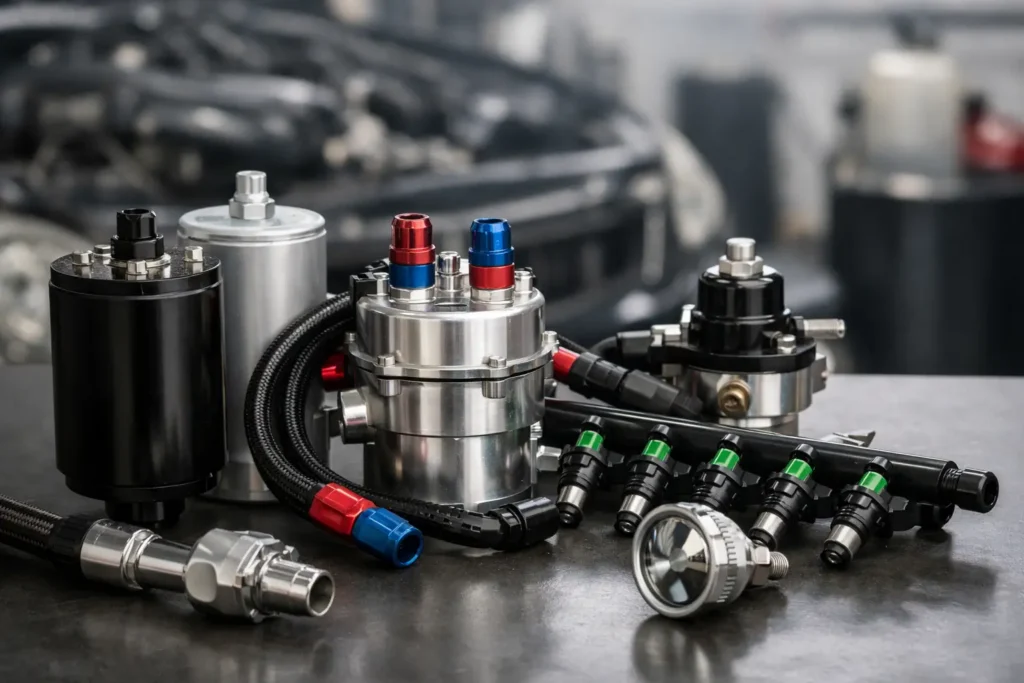
More power usually gets blamed on the turbo, cams or map. Then the car leans out at high load, fuel pressure drops off, or the injector duty cycle is already on the limit. That is where fuel system upgrades stop being an optional extra and start being the difference between a strong setup and an expensive failure.
A proper fuel system build is not about throwing the biggest pump and injectors at the car and hoping for the best. It is about matching fuel delivery to the engine’s airflow, the fuel type, the power target and the way the car is used. A fast road build has different demands to a drift car living on limiter, and both need a different approach again compared with a circuit car seeing sustained load and heat.
Why fuel system upgrades matter
The standard fuel system is designed around factory power, factory duty cycles and factory safety margins. Once boost goes up, compression changes, or ethanol enters the plan, those margins disappear quickly. The engine only cares about one thing – whether the correct amount of fuel arrives at stable pressure when it is needed.
That means every part in the chain matters. The pump has to supply the volume. The wiring has to support the pump. The lines and fittings have to carry that volume without restriction. The rail has to distribute fuel consistently. The regulator has to maintain pressure accurately. The injectors have to deliver the required flow with enough control at idle and part throttle to keep the car usable.
Weakness in one area can make the whole package unreliable. A large injector set will not fix an undersized pump. A high-flow pump will not rescue a restrictive line setup. Good parts still need good system design.
Start with the real power target
The first mistake in most builds is guessing. If the target is vague, the parts list usually ends up wrong.
Set the target power level first, then decide the fuel type. Petrol and ethanol blends change everything because ethanol demands more fuel volume for the same power. A setup that is comfortable on pump petrol can be near the edge on E85. Forced induction changes the numbers again, especially on cars that see long high-load runs rather than short pulls.
You also need to be honest about future plans. If the car is on 400 bhp now but the owner is already shopping for a larger turbo, building the fuel system once often makes more sense than replacing parts twice. There is still a balance to strike though. Massive injectors and twin pumps on a mild street car can create unnecessary complexity, heat and tuning compromises.
Street, drift and race use all load the system differently
A fast road car spends much of its life at part throttle, so drivability matters. Injector control at low pulse widths matters. Noise from an oversized external pump matters. Heat soak after traffic matters.
A drift car sees repeated high-rpm transitions, long periods of lateral load and hard demand changes. Fuel slosh control, tank pickup design and surge protection become serious considerations.
A race car usually needs sustained supply under continuous load, with less room for compromise on temperature control, consistency and serviceability. In that environment, a tidy and accessible layout is not just nice to have. It saves time between sessions and makes fault-finding much quicker.
Pump choice is only half the job
Most people start with the pump, which is sensible, but the pump is rarely the whole answer. In-tank pumps suit many performance builds because they are compact, quieter and easier to package. External pumps still have a place in higher-output or motorsport setups, especially where service access and staged fuel delivery matter.
The pump needs to support the required flow at the actual operating pressure, not the marketing number on the box. Base pressure, boost reference and voltage all affect real output. A pump that looks perfect on paper can fall short once boost rises and wiring losses pull voltage down.
That is why upgraded wiring, relays and proper supply voltage matter. If the pump cannot see stable voltage under load, you are leaving flow on the table. For serious builds, this is basic hardware, not overkill.
Injectors need to match the setup, not the forum hype
Injector sizing gets a lot of bad advice. Bigger is not always better. You want enough headroom for the target power and fuel type without making the car awkward to tune at idle or cruise.
Modern injector technology has improved a lot, and quality injectors can behave well even at higher flow rates, but the keyword there is quality. Cheap injectors with inconsistent data create problems that no tuner enjoys fixing. If the plan is reliable power, buy injectors with proper characterisation data and a known reputation.
For port-injected builds, injector choice is usually straightforward once the power target is defined. Direct injection adds another layer, especially on newer performance cars where the low-pressure and high-pressure sides both need to be considered. In those cases, fuel system upgrades are often a combination of improved low-pressure delivery, upgraded high-pressure components and calibration work that ties the whole lot together.
Lines, rails and fittings are not just plumbing
Fuel lines and fittings are easy to overlook because they are less glamorous than pumps or injectors, but restrictions, poor routing and low-grade hardware can ruin an otherwise solid build.
Line size should be selected around actual demand and layout. Go too small and you create a bottleneck. Go unnecessarily large and packaging becomes harder with no real gain on many builds. The same applies to rails. A properly designed rail helps with consistent distribution and dependable supply, especially where injector size and duty cycle are increasing.
Material quality matters as well. Motorsport-style hose, secure fittings and sensible routing reduce the risk of leaks, vapour issues and long-term degradation. If the car sees hard use, heat shielding and distance from exhaust components should already be part of the plan.
This is also where good hardware pays off. Builders and workshops want parts that fit, seal properly and survive repeated maintenance. Saving a few pounds on fittings is rarely worth it when the system is carrying fuel under pressure in a hot engine bay.
Don’t ignore the regulator and return setup
A fuel pressure regulator is not a decorative extra. On return-style systems, it is central to keeping pressure stable and predictable. A quality manifold-referenced regulator helps maintain the right differential pressure across the injectors as boost changes.
Returnless systems can work well in many factory applications, but once power climbs, many builders move to a return-style conversion for better control and consistency. That is not automatically necessary for every car. It depends on platform, power target and how far the standard arrangement can be pushed safely.
If you do convert, think about the full layout. Feed, return, filtration and tank strategy need to work together. A badly planned return system is just a more expensive version of the original problem.
Filtration, surge control and tank hardware
Fuel filters should be chosen to suit both the pump and the injectors. Too restrictive, and flow suffers. Too coarse, and downstream components are exposed to debris. If the car runs ethanol, material compatibility becomes even more important.
On drift and circuit cars, surge tanks and proper tank pickups are often worth their place. Lateral and longitudinal loads can uncover pickups and create brief lean events that are enough to damage an engine. These issues do not always show up on a dyno, which is why some cars look fine in tuning and then struggle on track.
A well-thought-out tank and surge arrangement is about consistency. If the fuel supply changes with every corner or transition, the rest of the system never gets a fair chance.
The tune is part of the fuel system
Buying hardware is only half the job. Calibration is what turns a pile of parts into a usable package.
Larger injectors, different base pressure, revised fuel pressure control and ethanol content all need to be accounted for properly in the ECU. That applies whether the car is on a factory ECU with supported strategies or a standalone management system. Good hardware with poor calibration can still run badly, wash bores, foul plugs or run dangerously lean.
Data logging matters here. Fuel pressure, injector duty, air-fuel ratio and voltage tell you whether the system is doing what it should in the real world. If the car is used for competition, logging under actual track conditions is worth far more than assumptions.
Build once, build properly
The best fuel system upgrades are the ones that suit the car’s purpose, leave sensible headroom and stay reliable under real use. That usually means resisting the temptation to buy parts in isolation. Treat the system as one package, from tank to injector and from wiring to calibration.
For workshops and serious home builders, that approach saves time and money. For owners chasing dependable power, it saves engines. If the setup is being pushed harder than the factory ever intended, the fuel system deserves the same level of planning as the turbo, cooling and engine management.
Buy quality hardware, size it around real numbers, and leave room for the way the car will actually be driven. That is how you end up with a build that performs properly when it matters, not just one that looks right on a parts list.