

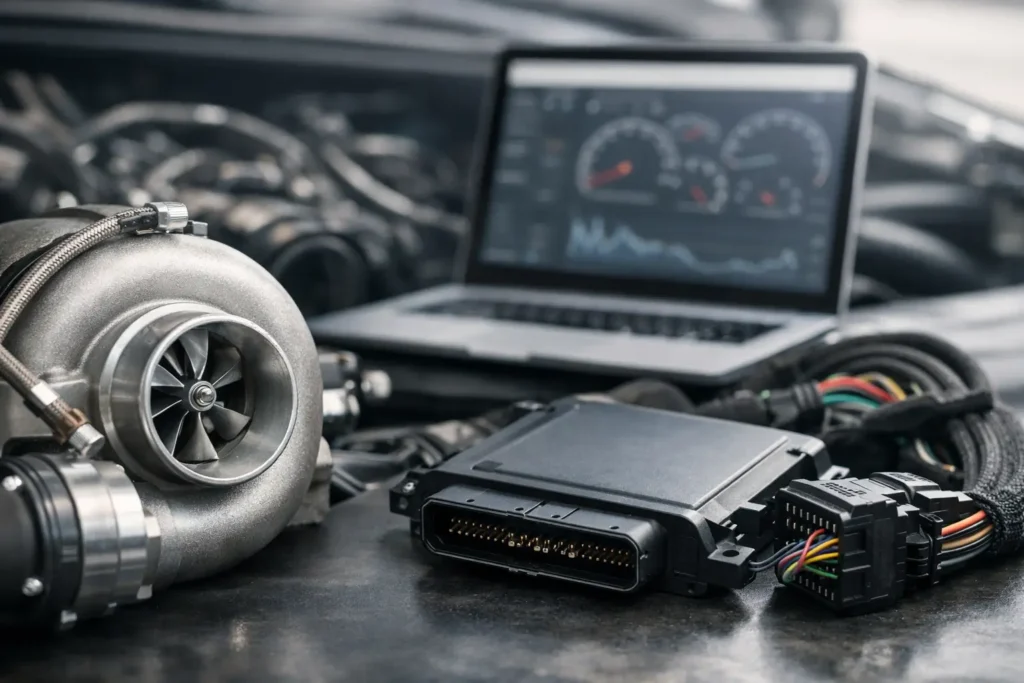
A turbo kit can be bolted on in a weekend. Getting it to run properly is the part that decides whether the car feels sharp, lazy, or one pull away from broken ring lands. Engine management for turbo conversion is where the build either starts making repeatable power or starts creating expensive problems.
Plenty of people still treat the ECU as the last item on the list, somewhere behind the manifold, intercooler pipework and wastegate. That is backwards. Once you add boost to an engine that was never calibrated for it, the ECU stops being a convenience and becomes the control centre for fuelling, ignition, boost strategy and engine safety.
Why engine management for turbo conversion matters
A naturally aspirated calibration simply does not have the load range, fuel delivery strategy or ignition control to cope with forced induction. Even on engines with decent factory ECU logic, the original system is usually designed around airflow, injector size, sensor range and knock sensitivity from a stock setup. Add a turbo and those limits show up quickly.
The first limit is usually fuel. Bigger injectors and a higher-capacity pump mean nothing if the ECU cannot control them correctly. Dead times, injector characterisation, short pulse behaviour and base pressure all matter. If those values are wrong, the engine may idle badly, run rich off boost and still go lean under load.
The second limit is ignition. Boost increases cylinder pressure. That means timing that was safe in naturally aspirated form can become risky very quickly. A poor ignition map will cost power at best and break pistons at worst. Good engine management gives the tuner proper control over load-based timing, compensation tables and knock response.
Then there is boost control itself. A basic wastegate spring may get the engine running, but it will not give consistent control across gears, temperatures and RPM. ECU-based boost control allows proper solenoid strategy, boost-by-gear, target mapping and fail-safes. On a street car that matters for traction. On a drift or race car it matters for consistency.
Piggyback or standalone ECU?
This is the decision that shapes the whole project. There is no universal answer because budget, vehicle platform, emissions requirements and power goals all change the equation.
A piggyback can work on some builds where the factory ECU remains useful for CAN functions, dash communication or immobiliser integration. It is often the cheaper route up front. For mild boost on engines with well-understood tuning support, it can do the job. But piggybacks are usually a compromise. They manipulate signals rather than fully controlling the engine, and that can become messy once injector size, MAP scaling, boost control and safety strategies move beyond basic territory.
A standalone ECU is the cleaner solution for most serious builds. It gives direct control over fuelling, ignition, boost, idle, launch, closed-loop corrections and engine protection. It also makes sensor upgrades far easier. If the car is being built for drift, track or repeated hard road use, standalone management is usually money better spent than replacing failed parts caused by limited calibration control.
The trade-off is complexity. A standalone needs proper wiring, setup and calibration. Sensor selection matters. Trigger patterns need to be correct. Base maps still need real tuning. But if you want an ECU that fits the actual demands of a turbo conversion rather than forcing the conversion to fit stock electronics, standalone wins more often than not.
The hardware your ECU needs to control
An ECU is only as good as the information it receives and the hardware it commands. Turbo conversions often fail because the parts list focuses on shiny boost hardware while ignoring the systems that make the calibration stable.
A proper MAP sensor is essential. If the factory sensor only reads vacuum and light load, it is finished the moment boost arrives. Intake air temperature is another big one. Post-intercooler air temp data is vital because charge temperature has a direct effect on ignition safety, fuelling and repeatability.
Injector choice needs more thought than just cc/min figures from an online calculator. Injector size should suit the power target with sensible headroom, but drivability matters too. If the injectors are too large and poorly characterised, the engine may be miserable at idle and cruise. That is not a tuning problem every time – sometimes it is simply the wrong injector for the application.
Fuel pressure control must also be stable. A rising-rate regulator is not a substitute for correct ECU calibration. You want predictable base pressure, enough pump capacity, proper wiring to the pump, and lines and fittings that will not become a restriction once duty cycle climbs.
On the ignition side, coils need to be up to the job. More boost means more demand on spark energy and plug condition. Closing the plug gap may help, but weak coils, poor dwell setup or voltage drop will still show up as misfire under load.
Tuning priorities that separate a strong build from a noisy one
The best turbo conversions are not always the highest-power ones. They are the cars that start cleanly, idle properly, hold stable AFRs, respond sharply and survive repeated use.
That starts with load calculation. Whether the ECU uses speed density, alpha-N blend or another strategy, the tuner needs a stable way to model airflow across the engine’s real operating range. On most turbo road and race builds, a well-configured speed density setup with accurate MAP and air temperature data is the logical approach.
Fuel mapping comes next, but not in isolation. Transient response matters just as much as wide-open throttle numbers. If throttle enrichment is poor, the car will feel flat or hesitant even if full-load AFR looks fine on the dyno graph. That matters on corner exit, during clutch kicks and whenever the engine sees fast throttle movement.
Ignition mapping needs discipline. More timing is not automatically more power once the engine is under boost. Combustion efficiency, fuel quality, chamber design, compression ratio and charge temperature all affect the limit. A safe map on quality pump fuel in winter may not be safe on a hot summer session after repeated heat soak.
Boost control should be calibrated with the whole package in mind. Chasing peak boost without considering turbine efficiency, backpressure and intake temperature is how you build a dyno number rather than a fast car. Often the better setup is less peak boost with cleaner ignition demand, lower exhaust stress and stronger mid-range.
Safety strategies are not optional
If you are spending proper money on a turbo build, engine protection should not be the part you skip. Modern engine management can do far more than make power. It can save the engine when something goes wrong.
At a minimum, boosted cars benefit from protection based on boost deviation, lean AFR, low fuel pressure, high coolant temperature and excessive intake air temperature. Oil pressure protection is also worth serious attention, especially on track and drift cars that see long lateral load and sustained RPM.
These strategies need to be set up sensibly. A limp mode that cuts power every time the car sees a harmless transient is frustrating. A threshold set too loose is pointless. Good calibration means building protections that intervene early enough to matter but intelligently enough to avoid nuisance cuts.
Knock control is another area where people get overconfident. If the ECU supports proper knock strategy and the tuner knows the platform, it can be a valuable safety layer. It is not magic. False knock, engine noise and poor sensor placement can all confuse the system. Treat it as backup, not permission to run a reckless ignition map.
Common mistakes with engine management for turbo conversion
One of the biggest mistakes is sizing the ECU for the first stage of the build instead of the real end goal. If the plan is to run bigger injectors, flex fuel, boost-by-gear, staged injection or extra sensors later, buying an ECU with no spare inputs or outputs just creates cost twice.
Another mistake is underestimating wiring. Bad joins, poor grounds, incorrect shield routing and weak power supply can create faults that look like tuning issues. Many supposed ECU problems are wiring problems in disguise.
People also get fixated on headline power and ignore control strategy. A car with average peak power and excellent mapping is usually quicker, easier to drive and more reliable than a car with a bigger number and a rough calibration. Street cars need cold start, hot start and part-throttle manners. Competition cars need repeatability and protection under abuse. Both need more than a full-throttle fuel map.
The last common mistake is trying to tune around hardware that is not good enough. An ECU cannot fix injectors that do not flow consistently, a fuel pump that drops pressure, or an intercooler setup that heat-soaks immediately.
Choosing the right route for your build
If the target is a mild, low-boost conversion on a platform with strong factory ECU support, a sensible piggyback or remap-based solution may be enough. If the goal is a serious street build, drift car or race application where boost control, protection strategies and future expansion matter, a standalone ECU is usually the smarter move.
That is where buying from a supplier that understands complete boosted setups matters. It is not just about the ECU in a box. It is the injectors, sensors, boost control hardware, fittings, fuel system parts and cooling support that let the calibration work properly. ProSpeed Parts sits in that lane for a reason.
Turbo conversions reward the builders who treat engine management as the foundation, not the finishing touch. If the ECU strategy is right, the rest of the package has a chance to perform as it should – hard, clean and without drama when the boost comes in.