

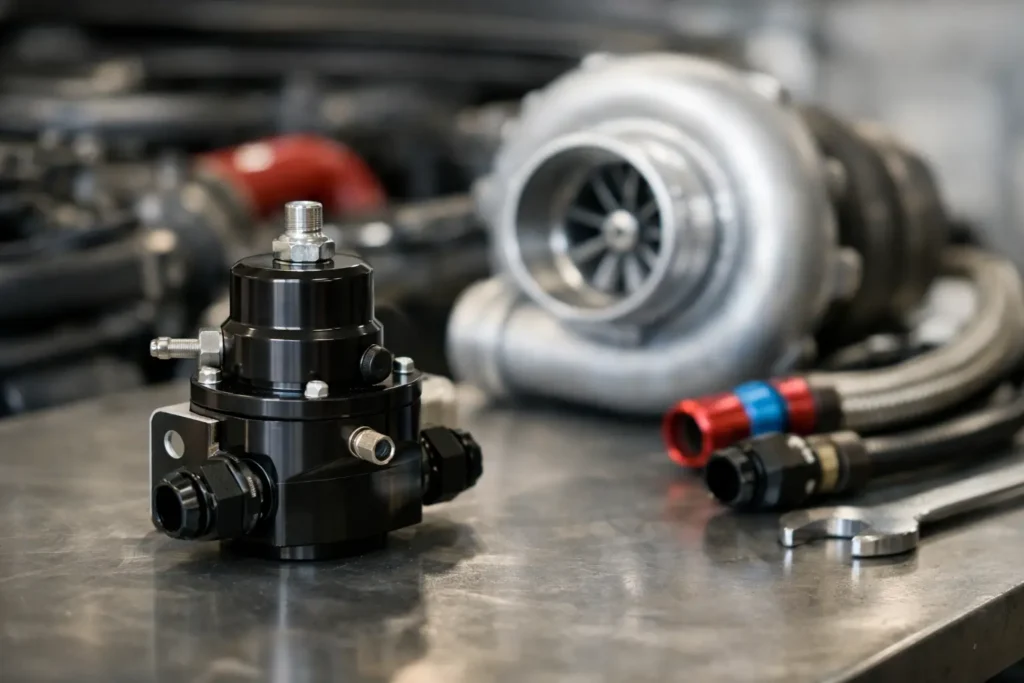
A turbo car that leans out under load rarely does it with much warning. One pull feels clean, the next shows unstable AFRs, fuel pressure falls away, and suddenly the whole build looks a lot more expensive. That is why the right fuel pressure regulator for turbo build planning is not a minor detail – it is a core part of keeping injector data predictable, fuel delivery stable, and the engine safe when boost comes in hard.
For street, drift, and race applications, the regulator has one job that matters more than anything else: maintain consistent pressure differential across the injectors. If it cannot do that accurately, the ECU calibration is working with moving targets. You can have good injectors, a capable pump, and decent lines, but if the regulator is slow to respond, poorly referenced, or simply undersized, the fuel system will never behave as it should.
Why the fuel pressure regulator matters on a turbo build
On a naturally aspirated setup, the regulator is still important, but a turbo engine raises the stakes. As manifold pressure climbs, injector effective pressure drops unless the regulator increases rail pressure in step with boost. That is why most forced induction setups use a 1:1 rising rate, manifold-referenced fuel pressure regulator. For every 1 psi of boost, fuel pressure rises by 1 psi, preserving the injector pressure differential the tune was built around.
This sounds simple, but real-world builds rarely stay simple for long. Bigger pumps can overwhelm a weak regulator at idle. Aggressive camshafts can create unstable vacuum signals. E85-compatible systems need materials that handle more than occasional ethanol content. A road car with modest boost and a single in-tank pump does not place the same demand on a regulator as a drift car on sustained load or a race car with dual pumps and high base pressure.
That is where people get caught out. They buy the regulator as an afterthought, based on thread size or price, when the correct choice depends on flow, pressure control, reference accuracy, and packaging.
What to look for in a fuel pressure regulator for turbo build use
The first point is pressure control range. Most turbo builds are happy around a 3 bar base pressure, sometimes 4 bar depending on injector strategy and calibration. The regulator needs to operate cleanly in that range and remain stable at both idle and peak flow. If base pressure drifts or creeps, tuning becomes inconsistent very quickly.
The second point is flow capacity. A regulator does not create fuel pressure on its own – it bleeds excess fuel back to the tank in a return-style system. That means it must be able to bypass enough fuel when the pump is working hard but injector demand is low, especially at idle and part throttle. If the bypass capacity is too small, pressure rises above target. This is common on builds using large pumps with a regulator designed for milder setups.
Reference signal quality matters just as much. A boost-referenced regulator needs a proper manifold pressure source, not a questionable feed shared with multiple solenoids and gauges through a maze of tees. Long hose runs, tiny internal diameters, or poor routing can delay regulator response. On boost, delay is not your friend.
Materials and compatibility also deserve attention. If the car is likely to run pump fuel now and ethanol blend later, buy accordingly from the start. Diaphragm and seal quality matter. Cheap regulators often look fine out of the box but struggle with pressure stability, develop leaks, or react inconsistently once heat and fuel chemistry take their toll.
Return-style versus returnless systems
For most serious turbo builds, return-style fuel systems remain the preferred option. They offer more accurate pressure control, better support for higher flow, and easier integration with aftermarket rails, pumps, and filters. A quality manifold-referenced regulator is central to that layout.
Returnless systems can work on mild turbo conversions, particularly where the factory control strategy remains largely intact, but they become restrictive once power goals rise. Managing fuel pressure properly under changing boost and load becomes more complicated, and tuning flexibility is reduced. If the build is moving beyond a basic bolt-on package, return-style usually makes more sense.
That does not mean every build needs the biggest motorsport regulator on the shelf. A well-matched street setup will outperform an overcomplicated system with poor plumbing and no proper pressure monitoring. Spec the whole system as one package, not as disconnected parts.
Sizing the regulator with the rest of the fuel system
A regulator should never be chosen in isolation. Pump flow, line size, fuel rail volume, injector size, fuel type, and intended power all affect what the regulator needs to manage. If you are stepping into a higher-flow in-tank or external pump, check whether the regulator can bypass enough excess volume without pressure creep. If you are running twin pumps, the answer matters even more.
Line sizing plays a part here. Builders often focus on feed line diameter and ignore the return side, but a restricted return can stop the regulator doing its job. You end up chasing phantom tuning issues when the real problem is mechanical. The same applies to filters. A fine filter placed incorrectly or undersized for the application can add pressure drop and create unstable behaviour at the rail.
Mounting position also affects consistency. The regulator should be installed where plumbing is sensible, heat exposure is controlled, and the return path is efficient. Some layouts place the regulator after the rail so fuel pressure is controlled across the injectors directly. That is often the cleaner approach on custom return systems.
Common mistakes when fitting a turbo fuel pressure regulator
The most common error is using the wrong reference source. The regulator must see true manifold pressure and vacuum. If the reference line is connected before the throttle body, the regulator will not compensate correctly under boost. That leads to reduced injector differential pressure exactly when the engine needs stable fuel delivery most.
The next issue is assuming all adjustable regulators are suitable for turbo use. They are not. An adjustable regulator without proper boost reference is not the same thing as a 1:1 manifold-referenced unit. The distinction matters.
Another frequent mistake is setting base pressure incorrectly. Base pressure should normally be set with the vacuum or boost reference line disconnected, then checked again once connected. If that step is skipped, the whole calibration can be off before the car even leaves the dyno.
There is also the habit of blaming injectors or mapping for problems caused by regulator instability. If fuel pressure oscillates, drops under load, or rises unpredictably at idle, no amount of tuning polish will fix it. Mechanical control comes first.
How to know your regulator is not up to the job
Data usually tells the story. If commanded lambda and measured lambda separate under boost, fuel pressure should be one of the first checks. A proper sensor on the rail, logged against manifold pressure, will show whether pressure rises 1:1 as expected.
Idle symptoms can be revealing too. Pressure that will not settle, rich idle with a large pump, or base pressure that changes as the car warms up can all point to regulator issues. So can hard hot starts, especially when residual pressure behaviour is inconsistent.
On track or in drift use, heat and sustained load expose weak components fast. A regulator that seems acceptable on the road can become unstable after repeated high-RPM pulls. That is why proven hardware matters. Cheap parts tend to reveal their real cost once the car is driven properly.
Choosing for street, drift, or race use
A fast road turbo car usually needs reliability, compact packaging, and enough overhead for future upgrades. A quality 1:1 regulator from a recognised performance brand is usually the sensible move, paired with fuel system hardware that matches the intended power rather than today’s modest boost level.
Drift and circuit cars need more margin. They see long periods of load, higher fuel temperatures, and more vibration. Consistency matters more than saving a small amount on hardware. A regulator with known flow capacity, stable control, and proper fuel compatibility is worth buying once.
Full race builds demand the same thinking, just with less tolerance for compromise. If the fuel system is being designed around staged pumps, ethanol fuel, or very high injector flow, regulator choice should be treated as a specification item, not a finishing accessory. That is the point where specialist stock from suppliers who understand motorsport plumbing, fittings, and fuel system layouts saves time as well as engines.
The right regulator will not make power on its own, but it gives the rest of the fuel system a stable platform to work from. That is what makes mapping repeatable, injector behaviour predictable, and boost something you can use with confidence rather than hope. If you are planning a turbo build properly, choose the regulator early, size it with the full system in mind, and leave enough headroom for where the car is likely to go next.