

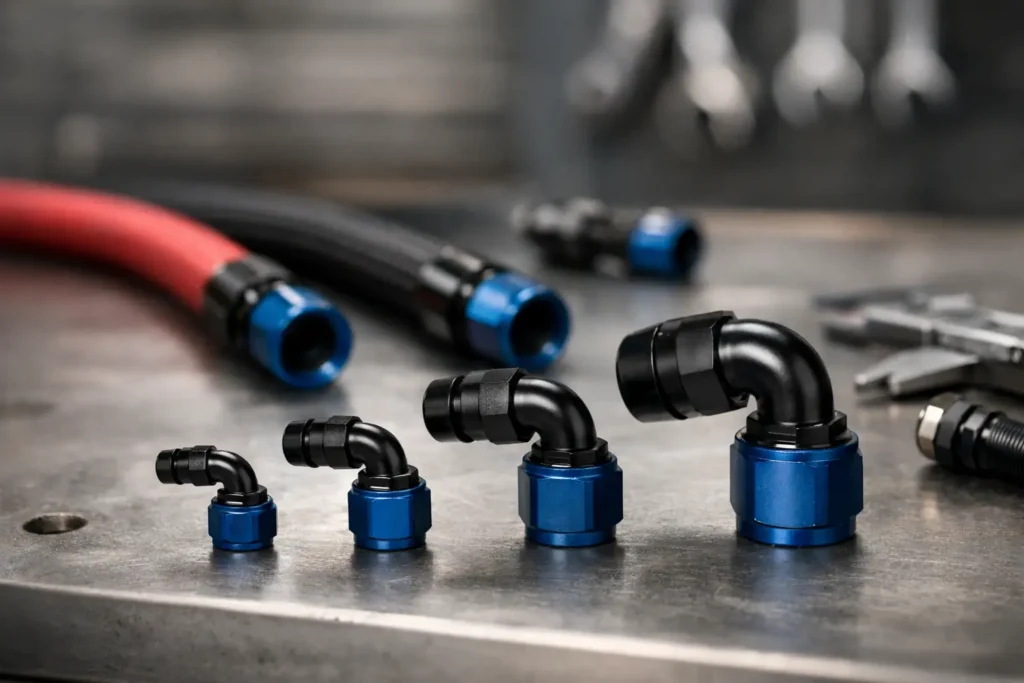
If you have ever ordered hose and fittings for a fuel, oil or breather setup and ended up with parts that almost fit, you already know why push lock hose fitting sizes matter. In performance builds, almost right is usually wrong. A hose that feels loose on the barb, or a fitting that is correct in thread but wrong in hose size, is the sort of mistake that turns a quick install into a leak chase.
Push lock systems are popular for a reason. They are quick to assemble, clean-looking and ideal for many low to medium pressure fluid circuits found on street, drift and race cars. But the sizing catches people out because there are two different things happening at once – the hose side and the port side. Get both right and the system goes together fast. Mix them up and you waste time, hose and fittings.
How push lock hose fitting sizes actually work
When people talk about push lock hose fitting sizes, they are usually referring to the hose size in AN dash format. Common examples are -4, -6, -8 and -10. That number relates to the nominal inside diameter of the hose in sixteenths of an inch. So a -6 hose is roughly 6/16in, or 3/8in internal diameter. A -8 is roughly 1/2in, and a -10 is roughly 5/8in.
That is only half the story. The fitting may have a push lock barb sized for -6 hose, but the threaded end could be anything from male AN flare to NPT, BSP or a metric port adapter. You are not buying one size. You are buying a hose size on one end and a connection standard on the other.
That is where many builds go off course. A -6 push lock fitting is not automatically correct for every part in a -6 system. If your regulator, catch can, oil cooler or pump uses a different thread or seat type, the hose barb size can still be right while the port connection is wrong.
The common hose sizes and where they are used
In performance automotive use, a few sizes cover most jobs. -4 is often seen on vacuum reference lines, clutch lines in some setups, or lightweight auxiliary fluid circuits. -6 is one of the most common sizes for fuel feed, fuel return, breather lines and some oil lines. -8 steps up where more flow is needed, such as larger fuel feeds, gearbox cooling or crankcase ventilation. -10 is common on oil systems, catch can drains and larger breathers. Move beyond that and you are generally into specialist cooling, dry sump or very high-flow applications.
The right size depends on the fluid, temperature, pressure and volume you need to move. That sounds obvious, but there is no single best size. A naturally aspirated road car fuel return does not need the same line as a high-boost ethanol-fed drift car. Likewise, a rocker cover breather line is not sized like an engine oil cooler feed.
If you oversize everything, packaging becomes harder and the hose can feel clumsy in tight bays. If you undersize it, you risk restriction, heat build-up or pressure drop. The smart choice is the size that suits the actual circuit, not the one that simply looks motorsport.
Hose size is not the same as thread size
This is the point worth double-checking before every order. Push lock hose fitting sizes describe the hose the barb is designed to retain. The threaded connection is separate.
For example, you might need a -6 push lock hose end with a 1/4in NPT male thread for a fuel pressure regulator. On another part of the same car, you may need a -6 push lock hose end with a -6 AN male flare to suit a bulkhead or inline filter. The hose side stays at -6, but the port side changes.
AN, NPT, BSP and metric threads are not interchangeable just because they look close. Thread pitch, taper and sealing method differ. AN relies on a flare seat. NPT seals on the thread taper. BSP can be parallel or tapered depending on type. Metric ports often seal with an O-ring or bonded washer. Force the wrong one in and it may hold briefly, but not for long.
What makes push lock different from braided hose ends
Push lock fittings are designed to work with specific socketless or push-on hose. The barb profile and hose construction are matched so the hose can be pushed over the fitting and retained without a separate reusable hose end shell. That makes installation faster and usually lighter than a braided stainless setup.
For the right application, that is a genuine advantage. A tidy fuel return, breather system or low-pressure oil line can be built quickly with fewer tools and less frustration. It also gives a cleaner install where a full braided assembly would be overkill.
The trade-off is pressure and temperature suitability. Not every push lock hose is intended for every fluid or every engine bay zone. Some are ideal for fuel and oil vapour but not for constant high heat near a turbo manifold. Some are fine for moderate pressure but not where you would normally specify PTFE-lined braided hose. Always match the hose specification to the job, not just the fitting size.
Push lock hose fitting sizes for fuel, oil and coolant
Fuel systems are where push lock is commonly used, especially for carburettor setups, low-pressure lift systems, returns and many EFI lines where the hose and fitting are rated accordingly. -6 is a frequent choice, though higher-powered applications may move to -8 for the feed depending on pump output, fuel type and target power.
Oil and breather systems often use -8 or -10. Catch cans, cam cover breathers and crankcase ventilation lines benefit from enough internal area to avoid restriction. On oil cooler circuits, it depends on the engine, oil viscosity and routing. Some combinations work well with push lock, while others are better served by higher-spec braided assemblies because of temperature and pressure exposure.
Coolant is more application-specific. Push lock can work in auxiliary coolant circuits, header tank lines or low-stress plumbing, but main cooling hoses usually call for dedicated coolant hose solutions with the right bend support and heat tolerance. Assuming one hose type can do every fluid job is where problems start.
How to measure the right size before you order
The cleanest method is to work backwards from the component ports and then confirm required flow. Check the port type on the tank, pump, regulator, cooler or adapter block. Identify whether it is AN, NPT, BSP or metric. Then choose the hose size needed for that circuit.
If you are replacing an existing line, do not rely purely on outside diameter. Hose wall thickness varies. Measure the internal diameter or read the markings on the hose if they are still legible. A hose can look close to another size from the outside and still be wrong.
It also pays to consider route length and bend radius. A long run with multiple bends may justify a larger size than a short, direct route on the same system. Flow losses are not just about fitting size. Routing matters too.
Fitment mistakes that waste time in the workshop
The first is mixing push lock hose with a barb that was designed for another hose type. It might go on, but retention and sealing are not guaranteed. The second is treating all -6 fittings as identical when the thread standard differs. The third is using push lock too close to extreme heat without protection or without choosing the correct hose material.
Another common issue is underestimating assembly effort. Push lock does not mean finger-push easy, especially with fresh hose. Clean cuts, light lubrication where approved by the hose manufacturer, and proper support make the job far easier. If the hose fights you all the way, stop and confirm compatibility rather than forcing it.
Clamp use is another depends-on-the-application area. Many push lock systems are designed to operate without clamps when the correct hose and fitting are paired within rated conditions. Some builders still use clamps for extra security in vibration-heavy environments. That can be sensible, but only if the clamp type and placement do not damage the hose.
Choosing sizes for a build that will actually work
For most enthusiasts and workshops, the sensible approach is simple. Pick the hose size based on the system’s flow demand. Match the fitting barb to that hose size exactly. Then match the threaded or flared end to the component port with no guesswork.
That sounds basic, but it is the difference between a clean first-time install and a bench full of nearly-correct parts. On custom cars, especially where space is tight around turbo hardware, dry sump components or fabricated tanks, planning the fitting angle matters as much as the size. Straight, 45-degree and 90-degree fittings all affect routing, stress and service access.
If you are building for hard use, give the fluid system the same attention you give the turbo, injectors or coilovers. A cheap or mismatched fitting can end a session faster than a part that looks far more dramatic.
Getting push lock hose fitting sizes right is not complicated once you separate hose size from port thread and choose for the actual job, not the catalogue photo. When the system is properly matched, push lock is quick, tidy and reliable – exactly what you want when the car needs to work first time.