

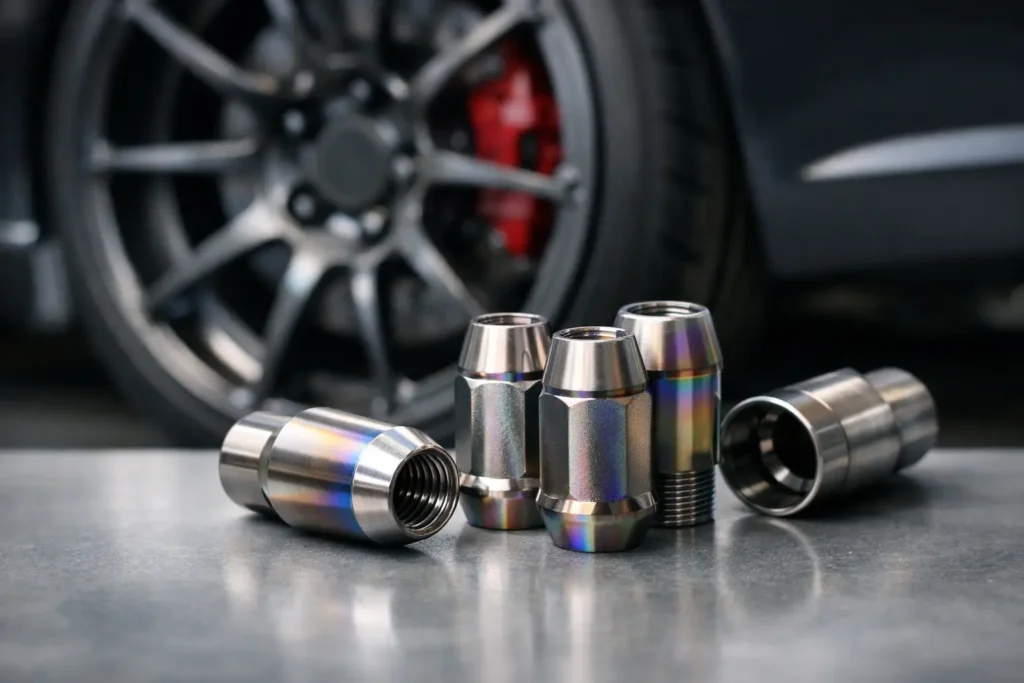
You notice titanium lug nuts long before you need them. They sit in that category of parts every serious builder has looked at – lightweight, premium, motorsport-flavoured, and priced high enough to make you stop and think. So, are titanium lug nuts worth it? The honest answer is yes for some cars and some owners, but they are far from an automatic upgrade.
If you are building a track car, a serious drift car, or a detail-focused street car where every component matters, titanium lug nuts can make sense. If your car is a daily with standard wheels and you just want something that works, a quality steel or forged steel lug nut is usually the smarter buy. The difference comes down to priorities: weight, corrosion resistance, appearance, service life, and budget.
Are titanium lug nuts worth it for performance builds?
On a proper performance build, titanium lug nuts offer three clear benefits. First is weight reduction. Second is corrosion resistance. Third is the premium fit and finish that appeals to owners who care about every visible detail. None of those points are marketing fluff, but none of them override basic fitment and quality either.
Titanium is lighter than steel, so changing from conventional steel lug nuts to titanium reduces rotating and unsprung mass at each corner. The actual weight saving is not huge in isolation, and anyone claiming lug nuts alone will transform lap times is overselling it. But performance cars are often built through cumulative gains. A little here, a little there, and the whole package becomes sharper. If you already spend money on lighter wheels, two-piece discs, aluminium suspension components, or titanium exhaust hardware, titanium lug nuts fit that same logic.
The second advantage is corrosion resistance. Good titanium hardware deals with road salt, moisture, brake dust and heat cycles better than many plated steel alternatives. That matters if you are constantly removing wheels for pads, tyre changes, setup work or transport. A lug nut that keeps its finish and does not seize itself into misery after repeated use has real value in a workshop or paddock environment.
The third point is harder to quantify but still relevant. Titanium hardware looks the part. On a clean wheel setup, especially with open-ended designs or exposed studs, it gives a car a more serious motorsport finish. For some buyers that is secondary. For others, especially on high-end street builds, it is part of the reason to buy.
Where titanium lug nuts make the most sense
Titanium lug nuts are easiest to justify on cars that get frequent wheel-off maintenance or where every component has been selected with weight and durability in mind. That includes time attack, circuit, sprint, drift and fast-road builds running quality studs and aftermarket wheels.
On those cars, the hardware is not being treated as a fashion item. It is part of a system. The owner is already paying attention to wheel stud material, seat type, torque values, spacer setup and brake temperatures. In that context, titanium lug nuts are less of a luxury and more of a considered specification choice.
They also suit show-quality performance cars where corrosion resistance and finish matter over years of ownership. Cheap anodised aluminium lug nuts often look good for a short time and then start to show wear, galling or rounded edges. Titanium tends to age better if it is properly manufactured.
For workshops and repeat customers, there is another angle. Fewer issues with rusted hardware, stripped finishes and poor tool engagement can justify paying more upfront, especially on customer cars where reliability and presentation both matter.
The trade-offs most buyers ignore
The biggest drawback is obvious: price. Titanium lug nuts cost far more than decent steel items. That means they only become sensible once the rest of the car is already sorted. If you are still running tired tyres, mediocre brake fluid, cheap wheel studs or questionable alignment settings, titanium lug nuts are not the best place to spend money.
There is also the issue of quality spread. Not all titanium lug nuts are equal. Cheap, unbranded sets can be badly machined, inconsistent in thread tolerance, or made from lower-grade material with poor quality control. On wheel hardware, that is not a small problem. If the seat profile is wrong or the threads are rough, you are risking damaged studs, poor clamping force and wheel security issues. Buy on specification, fitment and manufacturing quality, not just the word titanium in a listing.
Another trade-off is galling. Titanium can be prone to thread galling, especially when paired badly, installed dry in the wrong conditions, or repeatedly over-torqued. That does not mean titanium lug nuts are unreliable. It means they need to be installed properly, torqued correctly, and used with the right studs and any manufacturer-recommended anti-seize or lubrication guidance. Anyone fitting them like bargain-bin wheel nuts and smashing them on with an impact gun is asking for trouble.
Torque discipline matters
This is where motorsport-minded owners tend to get better results. They use a torque wrench, clean threads, inspect seats, and re-check after heat cycles. Titanium hardware rewards that kind of approach. If your normal wheel fitting method is full-send with a gun and no second thought, steel is the safer and cheaper answer.
Titanium vs steel vs aluminium
If you are weighing up materials, steel remains the default choice because it is strong, cost-effective and widely proven. For most fast road cars, steel lug nuts are still the benchmark for value and reliability. A good steel nut from a reputable manufacturer will handle repeated use, cope with abuse better than cheaper materials, and cost far less.
Aluminium lug nuts sit at the other end. They are light and often affordable, but they are usually the least suitable for hard use. On cars that see repeated wheel changes, aggressive torque cycles, high heat and real track abuse, aluminium hardware can wear quickly. Socket engagement can degrade, threads can suffer, and cosmetic finishes can fade faster.
Titanium sits in the premium middle ground where you want lighter hardware than steel without stepping into the compromises of aluminium. It is not cheap, but it offers a better balance of low weight, strength and longevity for demanding applications.
Fitment matters more than material
This is the part that matters most. If the thread pitch, seat type and overall lug design are wrong, the material does not matter. Conical, ball seat and flat seat designs are not interchangeable. Neither are different thread pitches. Open-ended and closed-ended styles each have their place depending on stud length and wheel design.
A correctly fitted steel lug nut is better than a badly chosen titanium one every single time. The wheel hardware is there to clamp the wheel securely to the hub. That job depends on proper interface and torque, not social media appeal.
For modified cars, especially those running aftermarket studs, spacers or motorsport hubs, this becomes even more critical. You need enough thread engagement, proper seat contact, and a nut design that suits both the wheel and the intended use. Any performance gain from titanium is irrelevant if the hardware choice is wrong from the start.
Are titanium lug nuts worth it on a road car?
Usually only if you genuinely value the premium material, lower weight and corrosion resistance. For a normal road car, they are more of a high-end finishing part than a necessary upgrade. You will not suddenly feel a dramatic change in steering or acceleration from the swap alone.
That said, enthusiast ownership is not always about necessity. Plenty of road cars get upgraded because the owner wants higher-quality hardware throughout the build. There is nothing wrong with that, provided expectations are realistic. Titanium lug nuts are not a substitute for tyres, suspension geometry, proper brakes or driver development.
The buying decision in plain terms
If your build is budget-led, buy quality steel and spend the savings elsewhere. If your car sees hard use, frequent wheel changes and careful maintenance, titanium lug nuts can be a worthwhile upgrade. If your goal is a premium, detail-driven build with motorsport-grade hardware throughout, they fit the brief well.
The right question is not simply are titanium lug nuts worth it. It is whether they are worth it on your car, with your usage, and at your stage of the build. For some owners the answer is clearly yes. For others, they are one of those parts best bought after the fundamentals are already handled.
Buy them for the right reasons: lower weight, strong corrosion resistance, quality hardware and a cleaner finish on a serious build. Not because they are trendy, and not because they promise performance they cannot realistically deliver. Get the specification right, fit them properly, and they are a smart detail. Get the priorities wrong, and they are just expensive wheel nuts.
If you are building with intent rather than chasing badges, the answer usually shows up quickly.