

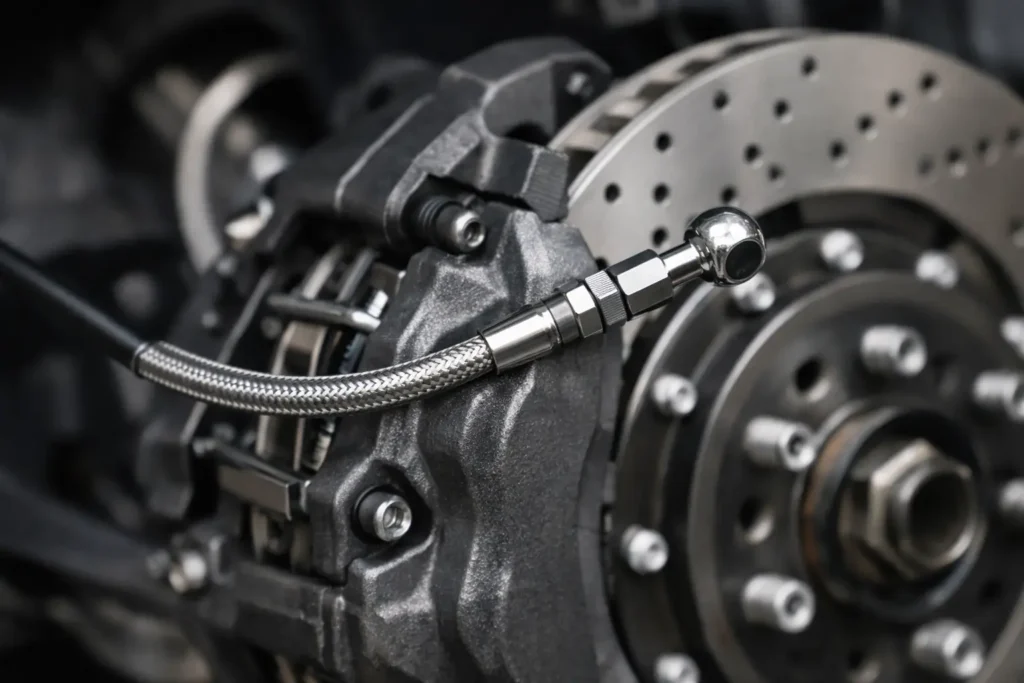
A long, soft brake pedal can ruin confidence long before it ruins a lap time. So, do braided brake lines improve braking? They can improve pedal consistency and feedback, particularly when the standard rubber hoses are ageing or the car sees repeated hard braking. They are not, however, a shortcut to shorter stopping distances on their own.
For a fast road, drift or track build, braided lines are best viewed as part of a complete brake system. Tyres, pads, discs, fluid, cooling and correct setup still determine how hard the car can stop. The lines help make the hydraulic connection between pedal and caliper feel more direct.
How braided brake lines change pedal feel
Most performance brake line kits use a PTFE inner hose wrapped in stainless-steel braid, often with a protective PVC outer coating. The PTFE core handles brake fluid, while the braid supports the hose and limits its ability to expand under pressure.
A conventional rubber hose is designed to flex, but it can expand slightly as hydraulic pressure rises. That expansion is normally small on a new, quality OEM hose. Under repeated heat cycles, age and road contamination, though, rubber hoses can become less consistent. Some swell internally, others soften externally, and both conditions can contribute to a less precise pedal.
Braided hoses reduce this pressure-related expansion. More of the pedal movement is therefore used to move caliper pistons and clamp the pads against the discs, rather than slightly expanding the flexible sections of hose. The usual result is a firmer, more repeatable pedal – not an artificially heavy pedal, but one that gives clearer information about what the brakes are doing.
That distinction matters. A firm pedal does not automatically mean more braking force. If the tyres have reached their grip limit or the ABS is cycling, a braided line cannot create extra tyre adhesion. What it can do is make it easier for the driver to modulate braking pressure accurately, especially approaching threshold braking or trail braking into a corner.
Do braided brake lines improve braking distance?
In a properly maintained road car fitted with fresh rubber hoses, the reduction in a single emergency-stop distance may be negligible. The car’s stopping distance is primarily governed by tyre grip, road surface, vehicle weight, pad friction, disc condition and brake balance. Modern ABS also prevents a driver from gaining much through pedal feel once the system is already operating at the limit of tyre grip.
Where braided lines earn their place is consistency. On a mountain road, a drift day or a circuit session, the brakes are asked to work repeatedly and at higher temperatures. A solid pedal helps the driver judge braking points and pressure with greater confidence. If the original hoses are old, the improvement can be immediately obvious.
A braided line upgrade is especially worthwhile when it accompanies higher-temperature fluid and suitable pads. Old fluid absorbs moisture over time, reducing its boiling point. Once fluid starts to boil, vapour compresses and the pedal can travel dramatically – a problem braided hoses cannot fix. Likewise, a pad that fades at track temperatures will still fade, no matter how good the hoses are.
The practical answer is simple: braided lines improve the control side of braking. They can contribute to better real-world braking performance because a driver with a predictable pedal can brake more accurately. They do not replace the components that generate stopping force.
When the upgrade makes the most sense
A braided brake hose kit makes strong sense if you are refreshing an older chassis, upgrading calipers, building a track car or replacing damaged standard flexi hoses. It is also a sensible supporting modification for cars running performance pads, larger brake kits or high-boiling-point fluid.
For drift cars, a consistent pedal is valuable when transferring weight aggressively, using left-foot braking or making repeated high-speed entries. For circuit cars, the benefit is more about repeatability over a session. For a fast road car, the improvement may be subtle with healthy OEM components, but it can still sharpen the driving experience and provide a durable replacement during a brake overhaul.
It depends on the baseline. Replacing cracked, tired rubber hoses with quality braided items can feel like a major change. Replacing near-new OEM hoses may feel more like refinement. Neither outcome makes braided lines a poor choice – it simply sets realistic expectations for the money spent.
Braided lines are not all the same
Do not buy a hose purely because it has stainless braid. A brake hose is a safety-critical hydraulic component, and the finished assembly matters as much as the material. Correct hose length, end fittings, crimp quality, banjo angle and vehicle-specific mounting points all need to be right.
A quality kit should be built for the application, using correctly specified fittings and a protective outer layer where appropriate. An exposed stainless braid can rub through adjacent components if it is incorrectly routed. A PVC-coated line adds a barrier against abrasion and helps protect paintwork and suspension parts from contact damage.
Universal hose and fitting systems have a place in specialist fabrication, race car plumbing and custom caliper conversions, but they demand careful planning. The hose must not pull tight at full steering lock, touch the wheel or tyre, rub on suspension travel, or kink as the car reaches full droop. On a road car, an application-specific kit is usually the cleanest and safest route.
Installation quality decides the result
A perfect line kit can still produce a poor pedal if it is installed badly or the system is not bled properly. Brake work is not the place to rush, reuse questionable sealing hardware or improvise fitting orientation.
Before driving the vehicle, check four areas carefully:
- Hose routing through full steering lock and full suspension travel.
- Clearance from tyres, wheels, driveshafts, exhaust heat and sharp edges.
- Correct seating of banjo bolts, copper crush washers and retaining clips.
- A firm pedal after a complete bleed, with no fluid leaks at any connection.
Use the brake fluid specification required by the vehicle and components. DOT 4 and DOT 5.1 are commonly used in performance applications, but they are not interchangeable with silicone-based DOT 5. Mixing incompatible fluids can create expensive problems. For cars used hard, fresh high-temperature fluid and regular fluid changes are often more valuable than chasing a headline fluid specification.
After installation, inspect the lines again following a short road test. Look for weeping joints, witness marks where a hose may be touching another component, and any change in pedal travel. A brake hose should never be treated as a fit-and-forget styling part. It is exposed to steering movement, heat, water, grit and vibration every time the car is used.
Build the brake system around the job
For a street car, start with tyre condition, pad choice and fresh fluid. If the rubber hoses are old or you want a more positive pedal, braided lines are a logical upgrade. For track use, combine them with fluid that suits the expected temperatures, pads matched to the disc and caliper setup, and enough cooling to prevent heat soak.
Do not overlook discs and caliper condition. Sticky slider pins, seized pistons, uneven pad deposits or poor bedding can make a car pull, judder or fade. None of those faults are cured by changing hoses. Equally, fitting aggressive track pads to a car that spends all winter on the road can bring noise, dust and weak cold performance. The right brake package is always application-led.
For custom builds, ProSpeed Parts customers should also consider the system as a whole: caliper inlet type, thread pitch, banjo size, mounting brackets, master cylinder capacity and ABS compatibility. A brake conversion that looks correct on a bench can have poor pedal travel if the hydraulic ratio is wrong.
The verdict for street, drift and track cars
Braided brake lines are a worthwhile upgrade when you want a firmer, more consistent pedal, are replacing ageing factory hoses, or are building a car that will see repeated hard braking. Their biggest gain is feel and confidence, not a guaranteed reduction in measured stopping distance.
Fit a quality, correctly specified kit, route it properly and bleed the system with fresh fluid. Then let the tyres, pads, discs and cooling do the work they are designed to do. A predictable pedal gives you the confidence to use the rest of the brake package properly – and that is where the upgrade pays back.