

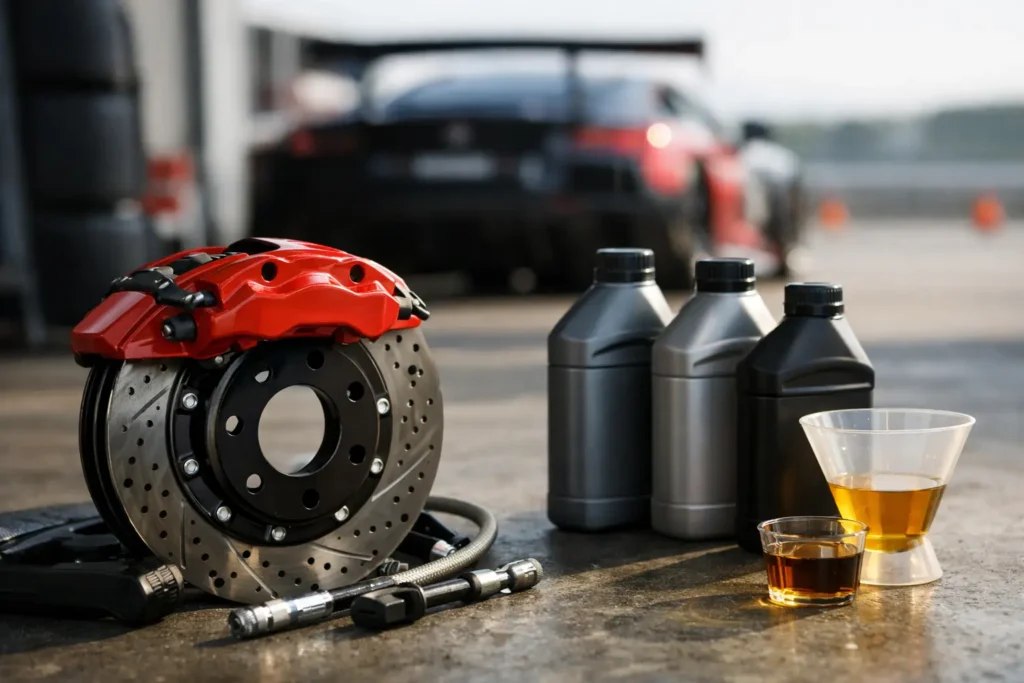
If your brake pedal goes long after a few hard laps, you do not have a pad problem until proven otherwise. Quite often, the real issue is fluid temperature. Choosing the best brake fluid for track use is less about brand loyalty and more about matching boiling point, maintenance interval and driving style to the way the car is actually used.
Track driving exposes the braking system to sustained heat that road use rarely touches. Heavy stops, short cooldown windows and repeated ABS intervention can push fluid beyond its comfort zone very quickly. Once the fluid starts to boil, vapour forms in the system, and vapour compresses. That is when pedal feel disappears, braking consistency drops off and confidence goes with it.
What makes the best brake fluid for track work?
The headline figures everyone looks at are dry and wet boiling point. Dry boiling point is the temperature the fluid can handle when fresh from a sealed container. Wet boiling point is the more realistic number after the fluid has absorbed moisture during service. Both matter, but for track cars that see real use, wet boiling point tells you more about how the pedal will feel a few events down the line.
A high dry boiling point is valuable if you flush fluid regularly and keep the system fresh. That is common on dedicated race cars, drift cars and serious track toys. If the car is driven on the road between events, or it sits for long periods, fluid moisture absorption becomes a bigger factor. In that case, strong wet boiling performance is often more useful than chasing the absolute highest dry number on the label.
Viscosity is another point that gets overlooked. If you run a modern ABS-equipped car hard, especially one with aggressive stability systems still active, the fluid needs to work properly through the control unit at temperature. Most quality performance DOT 4 fluids handle this well, but cheap fluid can show its limits here.
DOT 4, DOT 5.1 and why silicone is not the answer
For most fast road, track day and club motorsport applications, performance DOT 4 is the standard choice. It offers the best mix of high boiling point, compatibility and pedal feel. A premium racing DOT 4 fluid is usually the safest answer if you want one fluid that suits most performance builds.
DOT 5.1 can also offer high boiling points, and it is glycol-based like DOT 3 and DOT 4, so it is compatible in principle. But in practice, many experienced drivers still favour a proper motorsport DOT 4 because the product range is stronger in the performance market and the proven options are easy to source.
DOT 5 silicone fluid is the one to avoid for track use in almost all cases. It is not the same as DOT 5.1, it is not generally compatible with systems designed for glycol fluids, and it is a poor fit for serious motorsport braking systems.
Best brake fluid for track day cars vs race cars
This is where the right answer depends on the car.
A track day car that still sees road miles needs fluid with strong heat resistance but sensible service life. You want reliable pedal feel for repeated sessions without committing to constant flushing. For that kind of setup, a high-quality performance DOT 4 with a good balance of dry and wet boiling point is usually the sweet spot.
A dedicated race car is different. If the fluid is changed frequently and the car is maintained like a competition machine, it makes sense to prioritise outright dry boiling point. Endurance and sprint race setups often live on fresh fluid, so the downside of shorter service life matters less.
Drift cars sit somewhere in the middle. They can generate serious brake temperature, especially in rear systems with handbrake integration and repeated transitions, but usage pattern matters. A drift build used for demos and practice days may benefit from the same balanced approach as a track day car, while competition cars can justify more aggressive fluid choices and tighter maintenance intervals.
The numbers matter, but so does the maintenance plan
There is no magic fluid that fixes a neglected braking system. Even the best brake fluid for track conditions will underperform if it is old, contaminated or cooked by poor system design. Stainless braided lines, proper ducting, suitable pad compound and healthy seals all play a part.
The mistake many drivers make is fitting an expensive fluid once and assuming the job is done for the season. Brake fluid is hygroscopic. It absorbs moisture over time, and that drags the wet boiling point down. If you are running regular track days, fluid changes should be part of routine prep, not an afterthought.
As a rough rule, occasional track users should inspect and refresh fluid more often than they would on a road car, while frequent track and race users should plan scheduled flushes throughout the season. The harder the car is driven, the less sense it makes to stretch intervals.
How to choose the right fluid for your setup
Start with the car’s weight, speed and brake load. A lightweight hatchback on modest power puts less heat into the system than a heavy turbo saloon doing repeated high-speed stops. Then look at tyre grip. Sticky tyres increase braking force and heat load, so the fluid spec needs to keep up.
After that, be honest about how often you change fluid. If you are meticulous and happy to bleed the system regularly, you can lean towards more aggressive race-oriented fluids. If the car has to work on the road as well and you want strong performance without constant servicing, choose a premium fluid known for balanced dry and wet performance.
Also check caliper and master cylinder condition. Old seals, tired bleed nipples and heat-damaged components can make a good fluid look bad. The fluid should be the finishing touch to a sorted braking package, not the patch for a weak one.
Common mistakes when buying track brake fluid
The first is buying on dry boiling point alone. That headline number sells bottles, but it does not tell the whole story. A fluid with a massive dry figure can still be the wrong choice if it loses performance quickly in service.
The second is mixing old and new fluid without a proper flush. If the system already contains tired fluid, topping up with premium fluid will not give premium results. Contamination and moisture remain in the lines, calipers and ABS unit.
The third is ignoring the use case. A race-only fluid in a lightly used road and track car is not always the clever option. It may need more frequent replacement than the owner is realistically going to carry out.
The fourth is treating pedal fade and fluid fade as the same problem. Pads overheating and fluid boiling can feel similar from the driver’s seat, but they are not identical. If you get this diagnosis wrong, you can spend money in the wrong place.
A practical standard for most enthusiasts
For most enthusiasts, tuners and workshops building fast road and track cars, the best brake fluid for track use will be a recognised motorsport-grade DOT 4 from a reputable performance brand. That gives you the temperature resistance needed for repeated hard laps, broad compatibility with common braking systems and predictable service requirements.
If you are running a heavier car, a high-power build or sticky semi-slick tyres, lean towards the upper end of the performance range. If the car is a dedicated competition machine and fluid changes are routine, it makes sense to choose a more race-focused product with very high dry boiling performance. If the car is driven to the circuit, used hard and driven home again, balance matters more than outright spec-sheet bragging rights.
This is also where buying from a specialist supplier matters. You want product information that matches real-world use, not generic motor factor advice. A motorsport-focused catalogue makes it easier to source fluid alongside pads, lines, fittings and cooling hardware that work as a system rather than as isolated parts.
When you should change it immediately
If the pedal has gone soft after a session, if the fluid looks dark, or if you cannot remember the last full flush, change it. The same goes for a newly bought performance car with unknown service history. Brake fluid is cheap compared with the cost of running out of pedal at the end of a straight.
Fresh fluid also gives you a baseline. Once the system is flushed properly, you can assess whether any remaining issue is coming from pads, temperatures, caliper knock-back or mechanical faults elsewhere.
For serious track use, brake fluid should be treated like a consumable, not a lifetime fill. That mindset saves money, saves parts and, more importantly, keeps the car consistent when it matters.
The right fluid does not just raise a boiling point on paper. It gives you the same pedal in the last session as the first, and that is what lets you brake later, drive harder and trust the car when the heat is really in it.