

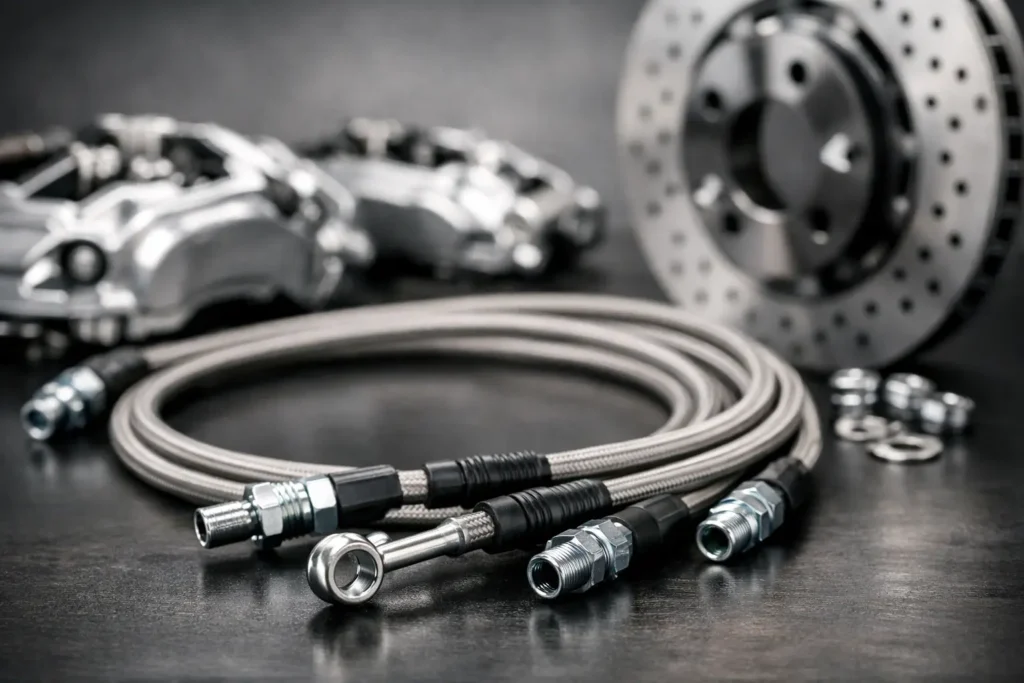
A brake pedal that goes soft after a few hard laps, a fast B-road run, or repeated heavy stops is usually blamed on pads or fluid first. Fair enough – they matter. But braided brake line kits are one of the upgrades that can sharpen pedal feel straight away, especially on modified street cars, drift builds and track-focused setups where the standard rubber hoses are already being pushed harder than the factory intended.
What braided brake line kits actually do
A standard rubber brake hose expands under pressure. On a normal road car used gently, that compliance is part of the original design and it does the job. Once temperatures rise and brake demand increases, that same flex can start to show up at the pedal as extra travel, a less direct response and reduced confidence when you need to lean on the brakes repeatedly.
Braided brake line kits replace those flexible rubber sections with hoses built around a PTFE inner and a stainless braided outer layer. The goal is simple – reduce expansion under hydraulic pressure. Less hose swell means more of your pedal input reaches the caliper instead of being lost in line flex.
That does not magically create braking torque. Your discs and pads still do the stopping. What the line kit changes is the consistency and precision of the system. On a properly bled setup, the pedal usually feels firmer and more immediate, which is exactly what most drivers are chasing.
Where braided brake line kits make the biggest difference
The biggest gains tend to show up on cars that already see harder use. If the car is driven spiritedly on the road, used for drift days, track sessions or fast road work with uprated pads and fluid, the standard hoses can become one of the weaker links in the system. That is where braided brake line kits start to make sense as part of a proper package.
On a lightly driven daily, the benefit can be subtler. You may still notice improved pedal definition, but it is not the same step change you get when the rest of the braking system is being worked hard. That is the trade-off. If the car never gets hot and never sees repeated heavy braking, the upgrade is more about feel and long-term durability than raw performance.
For drift cars, there is another angle. Pedal confidence matters when you are managing weight transfer and speed with quick inputs. A brake system that feels consistent run after run is easier to trust. For track and race applications, consistency under temperature is even more valuable.
Why pedal feel matters more than spec-sheet claims
Enthusiasts often talk about firmer pedal feel as if it is just a comfort feature. It is not. Pedal feel is feedback. A vague pedal makes it harder to judge threshold braking, trail braking, or the exact point where the front tyres are about to give up grip.
That is why braided lines are so common on serious builds. They are not a headline mod in the same way as big brake kits or coilovers, but they support the parts around them. Better pads, quality fluid and capable calipers all benefit from a hydraulic system that wastes less movement.
There is still some realism required here. If your fluid is old, the system has air in it, the master cylinder is tired or the pads are wrong for the job, braided lines will not fix that. They improve one part of the system. They do not cover up problems elsewhere.
How to choose braided brake line kits properly
Fitment comes first. Not all kits are equal, and this is not a category where close enough is good enough. The line length, end fittings, mounting points, thread types and banjo orientation all need to match the vehicle and the brake setup on it. If the car has had caliper conversions, suspension changes or steering angle modifications, checking compatibility becomes even more important.
Material quality matters too. A proper PTFE inner hose with stainless braid and correctly finished end fittings is what you want. Cheap lines can look the part and still fall short where it matters – crimp quality, corrosion resistance, protective outer coating and dimensional accuracy. On a braking system, that is not a place to gamble for the sake of a small saving.
It is also worth thinking about the intended use of the car. A road car that sees winter use may benefit from lines with a durable outer coating to help protect against road grime and corrosion. A competition car may prioritise heat resistance, low expansion and exact fit around aftermarket calipers or lock kits. Workshops and repeat buyers already know this, but it catches out plenty of private owners – buying by appearance is not the same as buying by specification.
Braided brake line kits and MOT or road use concerns
For UK road cars, buyers often ask whether braided lines are acceptable for road use and MOT inspection. In general, quality lines fitted correctly and in good condition are commonly used on road-going performance cars, but condition and installation are critical. The lines must not foul on wheels, suspension or bodywork, and they must not be twisted, stretched or routed in a way that creates abrasion.
That last point matters more than many people think. Even a high-quality hose can be damaged by bad routing. Full lock, full droop and full bump all need to be considered, especially on lowered cars or anything with altered steering geometry. A line that looks fine on stands can become a problem once the car is on the ground and moving through its range.
Installation is straightforward, but not casual
Fitting brake lines is not the hardest job on a build, but it does demand care. The old fluid should be handled properly, the unions need to be loosened without rounding them off, and the new lines should be installed without preload or twist. Once fitted, the whole system needs bleeding correctly with the right fluid.
If the car has ABS, a complex caliper arrangement or a full custom brake setup, taking shortcuts usually costs time later. A rushed bleed or a poor routing decision can leave you chasing a spongy pedal, leaks or line contact issues. That is why many workshops treat braided lines as a simple upgrade that still deserves proper process.
After installation, inspect everything again once the car has been driven. Check for weeping at fittings, verify line clearance at full steering lock, and make sure the hose sits naturally through suspension movement. This is basic workshop discipline, not overkill.
The usual mistakes buyers make
One common mistake is expecting braided lines to cure brake fade. Fade is usually heat-related and more often tied to pad compound, fluid boiling point, disc temperature or insufficient cooling. Braided lines can help maintain feel, but they do not replace the need for the right pad and fluid package.
Another mistake is mixing an upgraded line kit with tired old fluid and bargain pads, then judging the whole system on that result. Brake upgrades work best as a matched setup. If the car is genuinely used hard, think in terms of lines, fluid, pads and maintenance together.
The third mistake is forgetting that some modified cars do not suit off-the-shelf kits. If the vehicle has different calipers, relocated brackets, angle mods or unusual suspension travel, a standard kit may not route correctly. That is where specialist suppliers and proper specification checking save a lot of hassle.
Are braided brake line kits worth it?
For a performance-minded build, yes – usually. They are one of the cleaner upgrades you can make to improve brake feel without reinventing the whole system. The value is strongest when the car is already running better pads and fluid, or when it is used hard enough to expose the limitations of the standard hoses.
For a stock road car that is only ever used gently, the answer is more qualified. You may appreciate the sharper pedal and improved durability, but it is not always the first place to spend. If the car sees mixed use, fast road work or occasional circuit time, the case gets much stronger.
That is really the point with braided brake line kits – they are not about marketing noise or oversized claims. They are about making the brake system more direct, more stable and easier to trust when the pace rises. Choose a quality kit, make sure fitment is right, and treat installation properly. If you build cars to be driven hard rather than just looked at, it is an upgrade that earns its place.