

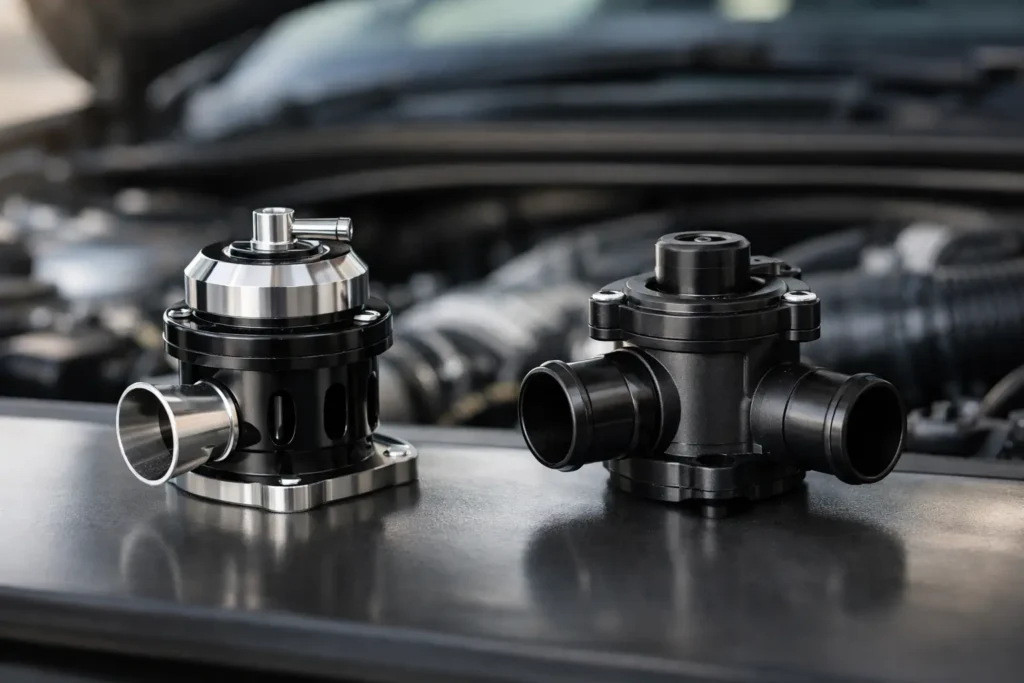
You hear it the first time a turbo car lifts off under boost – either a sharp atmospheric chatter or almost nothing at all. That sound usually starts the same question: blow off valve vs diverter valve, which one should you actually run? For a street build, drift car or circuit setup, the answer is not about noise alone. It comes down to how your intake system is metered, how you use the car, and what level of drivability you expect.
Both parts do the same core job. When the throttle closes and the turbo is still making boost, pressure backs up against the closed throttle plate. Without a release path, that compressed air can surge back against the compressor wheel. A valve opens to control that pressure. The difference is where the air goes and how that choice affects response, fuelling and overall behaviour.
Blow off valve vs diverter valve – the real difference
A blow off valve vents pressurised air to atmosphere when you lift off the throttle. That is what gives the familiar whoosh many owners want from a turbo setup. A diverter valve, sometimes called a bypass valve, sends that air back into the intake tract ahead of the turbo instead of dumping it outside.
Mechanically, they are solving the same problem. In practical terms, they behave differently depending on the engine management strategy. On a car using a MAF sensor before the turbo, the ECU has already measured that air. If an atmospheric blow off valve vents it, the engine can briefly run rich between shifts or on lift-off because the fuel calculation expected that air to remain in the system. On a speed density setup, that issue is usually far less relevant because fuelling is based on MAP, IAT and calibration rather than pre-measured airflow.
That is why this is rarely a simple good-versus-bad decision. One valve type is not automatically better. The right choice depends on the build.
How a diverter valve behaves on the road
For many OEM turbo applications, a diverter valve makes the most sense. It keeps the metered air in circulation, which helps maintain smoother transitions during part-throttle driving and gear changes. On a properly sorted street car, that often means better manners in traffic, cleaner recovery between shifts and fewer annoying fuelling quirks.
This is especially relevant on modern MAF-based cars where the owner wants OEM-like drivability with moderate tuning gains. If the target is a fast road setup rather than a noise-first build, a quality diverter valve can be the smarter hardware choice. It does the job without introducing side effects that then need to be tuned around.
There is also a packaging and refinement advantage. Recirculating systems are quieter by design, and for some owners that matters. Not every performance car needs to announce every lift of the throttle.
That said, not every factory diverter valve is good enough once boost and heat go up. Plastic OE units can leak, tear or lose control at higher pressure levels. Upgrading to a stronger piston-style or reinforced diaphragm-style diverter valve is often a reliability move as much as a performance one.
When a blow off valve is the better option
An atmospheric blow off valve makes more sense when the car is built around it. On speed density management, standalone ECUs, or properly calibrated conversions, venting to atmosphere is often no problem at all. In those cases, the valve can provide stable boost control, strong sealing under load and the response characteristics the setup needs.
For drift and motorsport applications, a blow off valve is often chosen for practical reasons beyond sound. Cars that see repeated aggressive throttle transitions need hardware that reacts quickly and consistently. A good valve with the correct spring pressure and signal reference can cope well with that abuse. It is also easier to package in some custom pipework layouts.
There is a common assumption that a blow off valve always improves performance. That is not really accurate. The performance gain usually comes from replacing a weak or leaking factory valve with a properly engineered aftermarket unit, not from venting to atmosphere by itself. If the original diverter valve is leaking boost, either a stronger diverter valve or a suitable blow off valve can fix the issue. The gain comes from sealing and control.
MAF, MAP and why calibration matters
If you are deciding between valve types, start with the airflow measurement strategy. This matters more than forum opinions.
On a MAF-based system, a diverter valve is usually the safer route. The air has been measured already, so recirculating it keeps the ECU’s expectations aligned with what the engine sees. Swap to an atmospheric blow off valve on the same setup and you can end up with rich stumbles, inconsistent idle after lift-off, or hesitation between shifts. Some cars tolerate it better than others, but it is a variable you need to account for.
On a MAP-based or speed density setup, an atmospheric blow off valve is generally much easier to run because fuelling is not based on that pre-turbo metering point. That does not mean every valve works perfectly out of the box. Spring rate, preload, vacuum signal quality and installation position still matter. A badly chosen valve can flutter when it should open cleanly, or leak when it should stay shut.
This is where matching components to the build matters more than chasing trends. Valve type, ECU strategy and boost target should be considered together.
Sound versus function
A lot of buyers start with the sound question, and that is fair enough. Turbo cars are emotional machines. But the sensible way to approach it is function first, sound second.
If the car is a daily-driven MAF setup and you want clean road manners, a diverter valve is usually the better fit. If it is a custom turbo build on standalone management and you want the unmistakable release noise, a blow off valve can be the right choice with no real compromise.
The problem starts when owners fit an atmospheric valve to a setup that does not want one, then try to ignore the poor behaviour because it sounds good. That trade-off gets old quickly if the car hesitates at junctions, smells rich after shifts or becomes irritating in normal use.
Choosing the right valve for your setup
The valve itself still needs to be chosen properly. Build quality matters. So does the valve design, whether piston or diaphragm, the spring range, boost capability and the flange or fitting style for your pipework.
For a mild fast-road car, you may prioritise stable drivability, OEM-style response and long-term reliability. For a high-boost track or drift application, you may need a valve that holds pressure confidently, reacts fast under repeated load changes and suits custom fabrication. Neither requirement is wrong, but they are different.
It is also worth paying attention to the vacuum source. A poor signal line, weak hose or incorrect routing can make a good valve behave badly. The same goes for cheap copies. This is one of those parts where poor machining and inconsistent spring control cause real headaches. Reliable branded hardware is worth it because the valve has to work every single time you lift.
For workshops and serious builders, this is usually where specialist stock matters. Having access to proven turbo accessories, proper fittings, clamps and compatible installation hardware saves time and avoids the kind of issues that come from trying to make generic parts work on a specific build.
Common mistakes with blow off valve and diverter valve setups
One of the biggest mistakes is assuming the loudest option is the best option. Another is fitting a valve purely because someone else used it on a different platform with a different ECU strategy.
A close third is ignoring boost leaks. If the car is underperforming, do not blame the valve type first. Pressure test the system. Check the valve is sealing, inspect the hoses, verify the vacuum reference and make sure the spring is right for the engine’s idle vacuum and boost level.
There is also confusion around compressor surge versus valve flutter. Not every noise is healthy, and not every chatter means the setup is working correctly. Some valves are adjusted or sprung too stiff and do not open as they should. That can create behaviours owners mistake for a desirable sound. It may not kill the turbo immediately, but it is not good setup practice.
Which should you buy?
If your car runs a MAF sensor and you want proper street manners, choose a quality diverter valve unless you are also changing the tuning strategy. If the car runs speed density, standalone management or a calibration designed for atmospheric venting, a blow off valve can work very well.
For many road cars, the sensible answer is a strong recirculating valve. For many custom performance builds, the answer is an atmospheric valve matched to the setup. The best choice is the one that suits the car’s hardware and use, not the one that makes the most noise on a short clip.
At ProSpeed Parts, that is how we look at turbo hardware – not as decoration, but as a working part of the system. Choose the valve that matches the management, boost level and intended use, and the whole car will feel better for it.
If you are still deciding, start with one honest question: do you want the right noise, or the right result? On a well-built turbo car, the best setups usually give you both.