

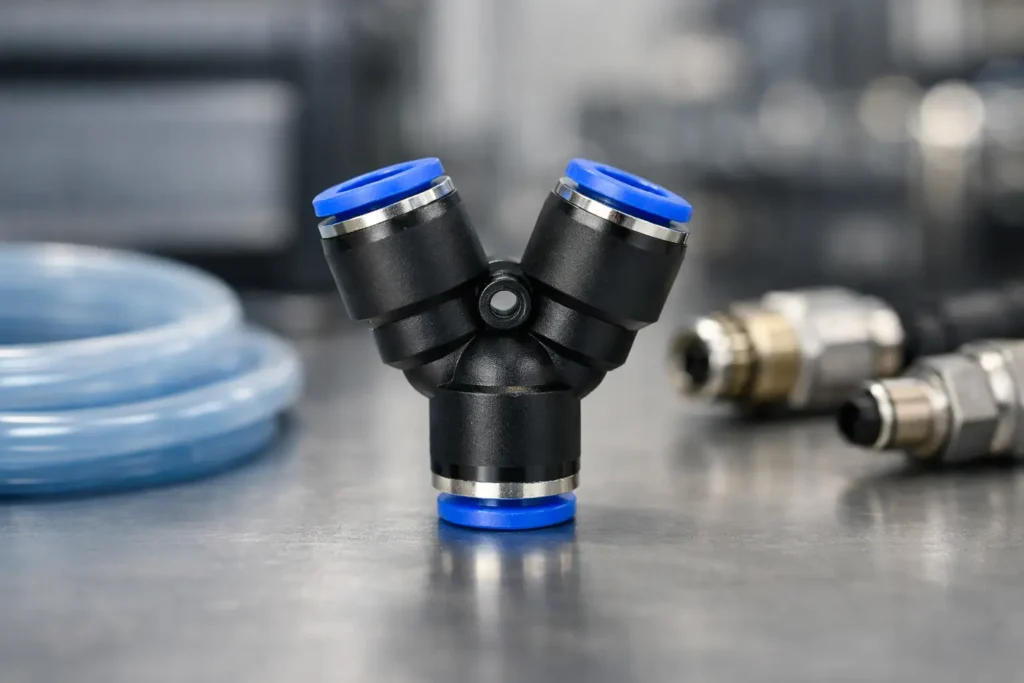
If your air system needs to split one feed into two lines without turning the plumbing into a mess, a pneumatic air fitting y block is usually the part that sorts it. On a custom performance build, that matters more than it sounds. Bad routing, poor flow choices, or the wrong thread spec can leave you chasing leaks, lazy actuator response, or packaging headaches that should never have been there in the first place.
What a pneumatic air fitting y block actually does
A Y block takes a single compressed air supply and divides it into two outlets through a Y-shaped internal path. The point is not just splitting the line. It is doing it with a smoother flow path than some tighter-angle alternatives, which can help where response and consistency matter.
You will see these used in pneumatic control systems, air suspension layouts, boost control plumbing, air-shift systems, air lockers, and workshop setups where one source needs to feed two circuits. In motorsport and modified road cars, the appeal is simple – fewer improvised joiners, cleaner routing, and a more serviceable install.
That said, a Y block is not automatically the right answer every time. If both downstream circuits need exactly matched pressure and near-identical hose lengths, layout matters. If one branch sees different demand from the other, the system may behave differently under load unless the rest of the setup is designed around it.
Why choose a pneumatic air fitting y block over a T-piece
This is where the details count. A T-piece is common, cheap, and perfectly usable in plenty of applications. But a pneumatic air fitting y block often gives you a cleaner angle for hose routing and a less abrupt path for airflow.
In a cramped engine bay, boot install, or underbody air system, that routing angle can be the difference between a tidy job and one that rubs through a hose after a few months. The Y format can also reduce strain at the fitting because the lines naturally leave the body at a more forgiving angle.
Flow is the other reason builders choose it. Air does not like sharp changes in direction. On high-demand or fast-response systems, smoother transitions can help reduce restriction. The gain will not always be dramatic, and on a basic low-demand setup you may never notice it, but on a properly sorted build small details stack up.
Where it makes sense on performance and race builds
On enthusiast and trade builds, Y blocks tend to show up where packaging, repeatability and reliability matter. Air suspension is an obvious example. If you are feeding paired circuits from a common source, a compact Y block can simplify line runs and make fault-finding easier later.
They also make sense in pneumatic control systems where solenoids, valves or actuators need a shared feed. For workshops building drift or race cars, clean plumbing is not just about looks. It makes maintenance quicker between events and reduces the chance of a line being kinked, overheated or damaged during service.
Some setups benefit from a Y block because of mounting options. Depending on the design, a block-style fitting can sit more securely than a generic inline splitter. That can help if the car sees vibration, heat cycles and constant strip-downs. Motorsport hardware gets handled hard. A part that stays put and seals properly is worth more than one that is merely cheap.
Sizing the pneumatic air fitting y block properly
This is where many problems start. Buyers often focus on thread size and forget flow capacity. Matching the ports is only part of the job. You also need to think about the internal bore, hose ID, operating pressure and the demand of the components downstream.
If the Y block is too small internally, it becomes a choke point. The system might still work, but response can be slower and pressure recovery can suffer. That matters on anything that relies on fast actuator movement or stable pressure delivery.
Thread specification is equally critical. BSP, NPT and metric threads are not interchangeable just because they look close at first glance. Forcing the wrong thread into an aluminium fitting is a good way to ruin both parts. On a serious build, always confirm the exact port standard, sealing method and hose connection type before ordering.
You also want to consider whether the fitting uses push-fit, compression, barb or threaded hose ends. Push-fit can be quick and tidy for certain pneumatic systems. Threaded connections may be preferable where heat, vibration or repeated service are expected. There is no single best option. It depends on the application and how hard the vehicle is used.
Material choice matters more than people think
A pneumatic air fitting y block might look simple, but material quality changes how it performs over time. Common options include brass, nickel-plated brass, aluminium and certain engineering plastics.
Brass is a solid all-rounder for many air systems because it resists corrosion well and seals reliably. Nickel-plated brass adds surface protection and often suits exposed environments better. Aluminium can be attractive where low weight and motorsport-style hardware matter, but thread quality and finish become especially important. Poorly made aluminium fittings can mark, gall or strip more easily than better-spec alternatives.
Plastic fittings have their place, especially in lighter-duty systems, but they are not always the best choice around engine bay heat or harsh vibration. For road and race applications, durability usually wins over saving a small amount of weight or cost.
This is exactly why serious buyers tend to stick with known-spec hardware from performance-focused suppliers. A fitting is a small part until it leaks on a mapped turbo car, an air suspension install, or a race setup that needs to work every time.
Sealing, pressure and reliability
Air leaks are rarely dramatic, but they are always annoying. The wrong sealant, over-tightened threads, damaged O-rings or poor thread compatibility will all create problems that waste time.
Some Y blocks seal on the thread itself, while others rely on an O-ring or bonded seal at the seat. You need to know which type you have before fitting it. Applying thread sealant to a fitting designed to seal elsewhere does not improve anything. It just makes future maintenance messier.
Pressure rating should never be assumed. Check the working pressure and temperature range against the real environment, not the ideal one on paper. Underbonnet heat, winter moisture, workshop contaminants and vibration all affect service life. If the system sees aggressive duty cycles, build in margin rather than aiming for the bare minimum spec.
Installation mistakes that cause trouble later
Most fitting failures are not actually fitting failures. They are installation errors. Cross-threading is common. So is over-tightening, especially with softer metals. Tight enough to seal is not the same as as-tight-as-possible.
Routing also matters. If one branch leaves the Y block under tension, the fitting body carries that load every time the car moves or the line pressurises. Support the hose properly, avoid sharp bends near the fitting, and keep the assembly away from abrasion and direct heat where possible.
Contamination is another overlooked issue. Swarf, tape fragments and dirt in the line can affect valves and actuators downstream. On a fresh build, clean every line and fitting before final assembly. It is basic workshop discipline, but it saves headaches.
When a Y block is not the right choice
Not every split line should use a Y. If your system needs isolated control between both downstream branches, a manifold or valve block may be the better option. If pressure drop has to be tightly controlled across multiple outputs, a purpose-designed distribution block usually makes more sense than a simple splitter.
Likewise, if one branch is significantly longer or feeds a much higher-demand device, the system may become uneven in operation. Sometimes that is acceptable. Sometimes it creates inconsistent performance that looks like an electrical or tuning issue when it is really a plumbing problem.
This is why experienced builders spec the whole system, not just the visible parts. The best pneumatic setup is the one that matches the job, fits cleanly, and can be serviced without tearing half the car apart.
Buying the right pneumatic air fitting y block
For performance customers, the buying checklist is straightforward. Confirm thread standard, connection size, material, pressure rating and intended environment. Then look at packaging. A fitting that is technically correct but impossible to route cleanly is still the wrong part.
It also pays to buy from a supplier that actually understands modified vehicles and specialist hardware. General automotive retailers often stock generic pneumatic pieces, but custom street, drift and race cars need better attention to compatibility and build quality. That is where a focused parts source such as ProSpeed Parts fits the job.
A pneumatic air fitting y block is a small component, but small components decide whether a build feels properly engineered or merely assembled. Choose one that matches the pressure, the routing and the standard of the rest of the car, and you will spend more time driving and less time hunting leaks.