

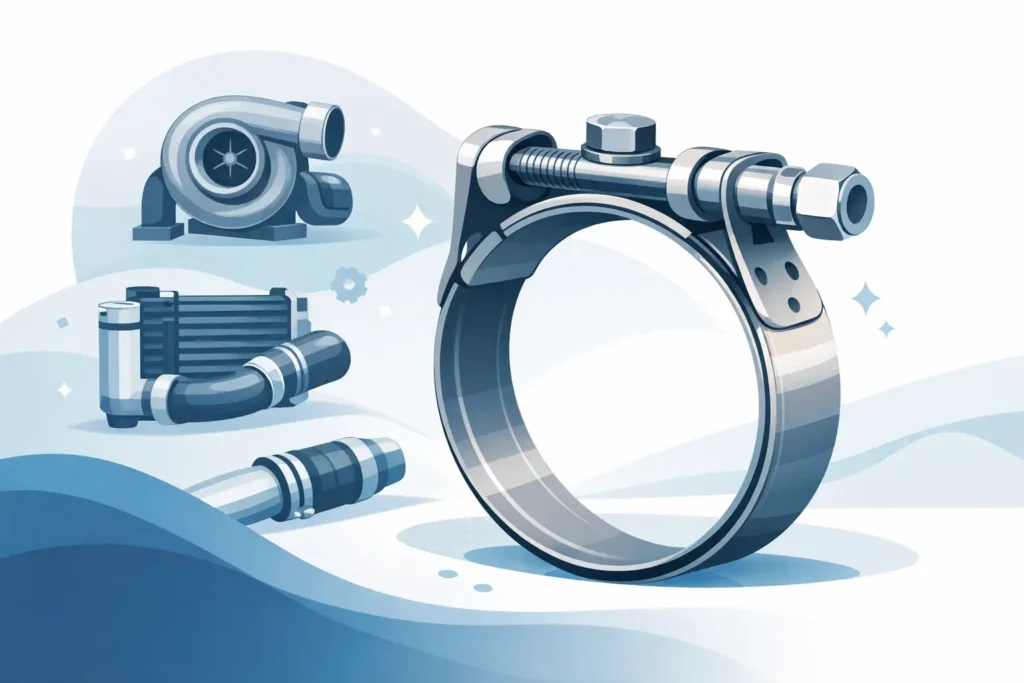
If you are asking what is a t-bolt clamp used for, the short answer is simple: it is used to secure hoses and couplers where pressure, heat, vibration and load are too much for a basic worm-drive clamp. In performance cars, that usually means boosted intake pipework, intercooler connections, coolant hoses, charge pipes and other areas where a clamp failure can cost power, create leaks or end a session early.
A t-bolt clamp is built for higher clamping force and better load distribution than the sort of jubilee-style clamp many people fit by habit. Instead of relying on a slotted band and screw housing, it uses a solid band with a T-shaped bolt and nut arrangement. That design gives more even pressure around the hose or silicone coupler, which matters when you are dealing with boost pressure, elevated under-bonnet temperatures and pipework that moves under load.
What is a t-bolt clamp used for on a performance car?
On a modified or race-prepped vehicle, a t-bolt clamp is most commonly used anywhere a hose joint needs to stay sealed under stress. Turbo systems are the obvious example. Intercooler couplers, boost pipe connections and intake plumbing all see pressure pulses and vibration. A weak clamp can let the coupler creep, leak or blow off completely.
That same logic applies to cooling systems. If you are running upgraded silicone hoses, alloy joiners or custom fabricated pipework, a t-bolt clamp can give a more secure hold than a standard clamp, especially when the system cycles from cold to full operating temperature repeatedly. They are also used on air intake systems, catch can plumbing, some oil system connections and heavy-duty fluid transfer setups where hose retention matters.
In workshop terms, they are chosen when the job needs proper clamping force, not just convenience. Street cars with mild upgrades may not need them everywhere, but once you move into higher boost, track use, drifting or endurance abuse, clamp choice stops being a small detail.
Why not just use a standard worm-drive clamp?
A worm-drive clamp is cheap, easy to find and perfectly usable in many low-stress applications. For basic breather hoses or light-duty coolant jobs, it can be enough. The issue is that it does not always apply pressure as evenly as a t-bolt clamp, and the band design can create localised force points.
On silicone couplers in particular, that matters. Uneven pressure can lead to sealing issues, especially on polished alloy pipe ends or systems that see rapid boost rise. Under higher loads, a worm-drive clamp can also distort more easily, back off over time or cut into softer hose material if overtightened.
A t-bolt clamp is not magic, and it will not fix a bad pipe bead or poor fitment. What it does do is give you a stronger, more stable clamp setup when the application demands it. That is why you see them so often on serious turbo builds rather than just standard replacement hose repairs.
Where t-bolt clamps work best
The best use case is a hose or coupler on a rigid pipe with a proper bead roll or retaining lip. That combination gives the clamp something to hold behind, reducing the risk of the hose walking off under pressure. Intercooler and boost pipework is the classic example.
They also work well on larger diameter hoses where a standard clamp starts to feel marginal. Radiator hoses, intake trunking and custom ducting can all benefit, provided the clamp size is correct and the hose material suits the load. Some heavy-duty diesel and commercial applications use them for exactly the same reason – stable clamping on larger, more demanding joints.
If you are building a drift, time attack or circuit car, it is common to spec t-bolt clamps on the charge system as a baseline reliability upgrade. That does not add horsepower on its own, but it helps keep the power you already have by reducing the chance of leaks and blow-offs.
What is a t-bolt clamp used for when boost goes up?
Once boost pressure rises, small weaknesses start to show. A coupler that seemed fine at modest pressure can begin to shift. A clamp that held on the road may fail on a hard pull, on anti-lag, or after repeated heat cycles at the track. This is where t-bolt clamps earn their place.
They are used to maintain sealing force across the full circumference of the coupler while resisting the tendency of the pipe joint to separate. On turbo cars, especially those with custom pipe routing, rigid engine mounts or aggressive mapping, there is more movement and more shock load in the system. That makes clamp security far more important than on a standard daily.
It is also worth mentioning that not all boost leaks are dramatic. Sometimes the clamp does not let go completely. Instead, you get a minor leak that hurts spool response, affects fuelling or causes inconsistent performance. A better clamp setup can help eliminate that kind of issue when everything else checks out.
Sizing and fitment matter as much as clamp type
The wrong size t-bolt clamp is just as bad as the wrong type of clamp. Too large, and it will bottom out before applying proper force. Too small, and you risk damaging the hose or struggling to install it correctly. The clamp needs to match the actual outside diameter of the fitted hose and pipe combination, not just the nominal hose size printed on the packet.
This catches people out with silicone joiners. A 63 mm coupler over a beaded alloy pipe does not necessarily need a 63 mm clamp. You need to measure the outside diameter once assembled and choose a clamp with the right working range. On a performance build, guessing usually ends up costing time twice.
Band width matters too. A wider band spreads load more effectively, which is helpful on softer hose materials and higher-pressure joints. Some t-bolt clamps also include a spring-loaded section to maintain more consistent tension through thermal expansion and contraction. That can be useful on systems that see major temperature swings.
Common mistakes when using t-bolt clamps
The biggest mistake is overtightening. Because a t-bolt clamp looks heavy-duty, people often assume tighter is always better. It is not. Too much torque can deform the hose, damage the coupler, distort thin-wall aluminium pipe or actually worsen sealing.
The second mistake is using them on poor pipe ends. If the pipe has no bead, no retaining lip and a rough fit, the clamp has to do too much work. A proper beaded pipe end is one of the most important parts of a reliable boosted hose connection.
Another common issue is mixing low-quality clamps with high-demand applications. On a hard-used car, clamp material and hardware finish matter. Corrosion resistance, thread quality and band strength all affect how the clamp performs over time. This is exactly why builders and workshops tend to buy known-spec hardware instead of the cheapest generic option available.
Are t-bolt clamps always the best choice?
Not always. If you are securing a small vacuum line, a low-pressure breather hose or a basic fluid hose with minimal load, a t-bolt clamp is usually excessive. They cost more, take up more space and are not the most practical answer for every connection under the bonnet.
There are also applications where constant-tension spring clamps or OEM-style hose clamps are better suited, particularly where the manufacturer designed the system around thermal movement and a specific hose material. On some coolant systems, the right clamp depends on hose construction, pressure, packaging and serviceability.
For most performance buyers, the sensible approach is simple: use t-bolt clamps where pressure, heat and retention demands justify them, and use the correct alternative where they do not. Good builds are about matching the part to the job, not fitting the most aggressive-looking hardware everywhere.
Choosing the right clamp for your build
If you are buying for turbo pipework, intercooler couplers or upgraded coolant plumbing, focus on material quality, clamp range, band width and whether the joint has a proper bead. Stainless construction is usually the right call for long-term durability, especially on cars that see wet road use, washdowns or repeated strip-downs.
Think about service access as well. A clamp that is technically correct but impossible to reach once the front end is assembled will become a nuisance. Experienced fabricators plan clamp orientation during mock-up for exactly that reason.
For serious street, drift and race setups, this is one of those small components that punches above its weight. A failed clamp can ruin a run just as quickly as a failed sensor or split hose. That is why specialist suppliers such as ProSpeed Parts stock proper motorsport-minded hardware instead of treating clamps like an afterthought.
A t-bolt clamp is used for keeping critical hose connections locked down when the car is working hard. If the system carries boost, heat or serious vibration, it is usually money well spent – and a lot cheaper than chasing leaks at the track.